Body Posture & Spine Analysis
Smart Posture & Scoliosis Screening
Markerless · 3D Scan · Dual-Dimension Assessment — scoliosis, pelvic tilt, and shoulder asymmetry screening
Core Advantages
Powered by 3D Vision AI, breaking through traditional assessment limitations
Highly Integrated
Portable design, small footprint, easy to move. No special space needed — adaptable to clinics, schools, and more.
Ultra-Easy Testing
Pure vision technology, no sensors or markers needed. Single operator, simple and efficient test flow.
High-Precision Data
Tsinghua University AI posture model precisely captures spatial coordinates, quantifying deviation magnitude and angles.
Comprehensive Screening
Supports scoliosis, pelvic tilt, shoulder asymmetry and more — covering both coronal and sagittal plane assessment.
Domestic Innovation
Software, hardware, and AI models all independently developed — technology fully self-controlled, adapted to local clinical needs.
Visual Reports
Assessment results presented visually with precise anomaly annotations, supporting rapid personalized treatment planning.
Feature Highlights
Covering the complete assessment workflow
Spinal Anomaly Screening
Covers scoliosis across cervical, thoracic, and lumbar segments. Precisely quantifies Cobb angle and deviation magnitude for early intervention tracking.
Full-Body Posture Assessment
Upper limbs (shoulder asymmetry), trunk (balance/rotation), hip (pelvic tilt), lower limbs (alignment/leg length discrepancy).
1-Minute Test Flow
Device setup → Patient stands naturally → Report generated in 1 minute with anomaly annotations, quantified data, and risk levels.
Report Example
Structured report template, precisely quantifying assessment characteristics
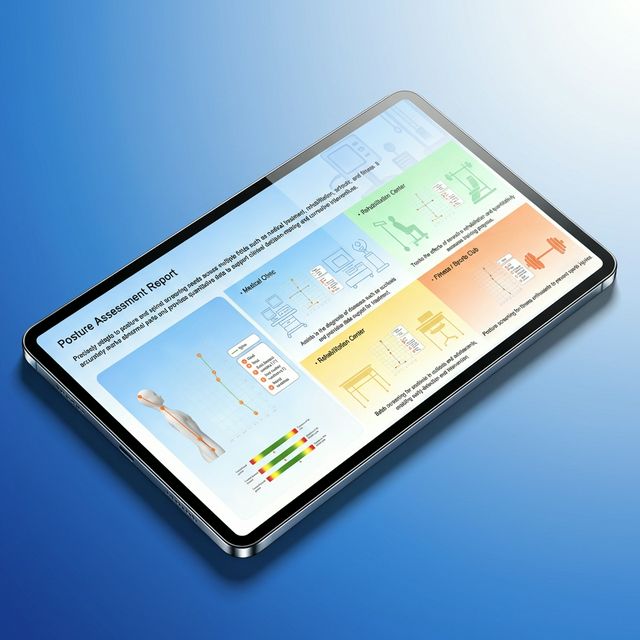
How to read and compare the report
The images on this page illustrate the HoloMotion report interface. Open the original image to inspect the layout; it is not a new accuracy experiment or evidence of treatment benefit.
Read parameter tables together with the recorded movement, side and angle convention. Check axes and units before comparing curves. A percentage displayed as a movement-risk index is not necessarily a calibrated probability of injury.
Before repeating an assessment, record product/version, task, camera position, lighting, clothing, assistance and trial-quality decisions. Compare only sufficiently similar trials and interpret change with professional context.