Empowering sports biomechanics teaching and laboratory research with markerless 3D motion capture, multi-modal data visualization, and research-grade data traceability.
At a glance
Advanced Bio-Research: Empowering sports biomechanics teaching and laboratory research with markerless 3D motion capture, multi-modal data visualization, and research-grade data traceability.
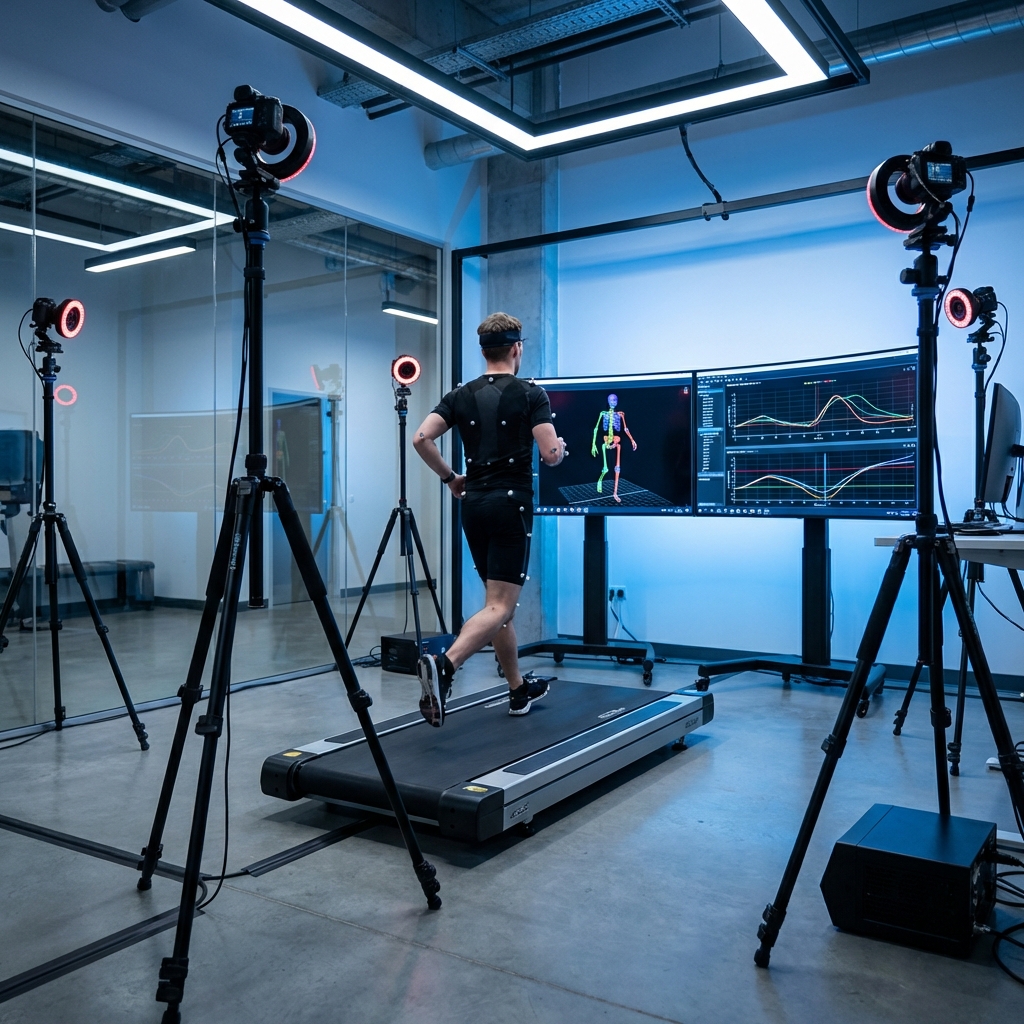
✦Markerless camera-based movement analysis provides joint-angle and biomechanical outputs; available measures and capture settings depend on the configured product and protocol.
✦Multi-modal visualization: tables, curves, and trajectory plots
✦Research-grade data export and multi-period comparison analysis
Markerless camera-based movement analysis provides joint-angle and biomechanical outputs; available measures and capture settings depend on the configured product and protocol.
Multi-Modal Data Visualization Teaching
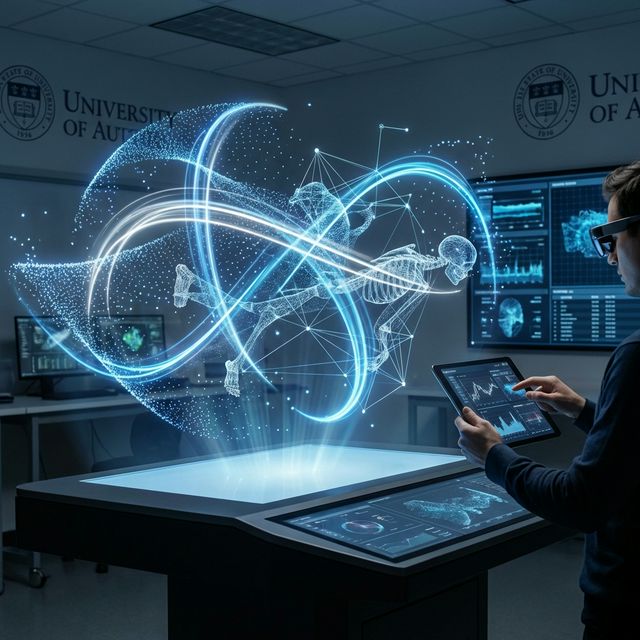
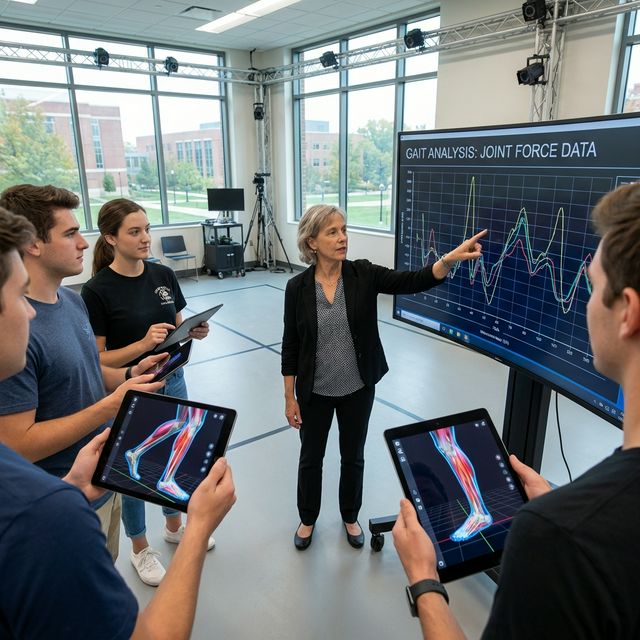
Provides table + curve + trajectory multi-modal data presentation including parameter tables, foot trajectory plots, and joint angle curves. Synchronized with test video for frame-level navigation, intuitively displaying joint angle dynamic changes and limb symmetry differences. Teachers can break down biomechanics principles using the charts while students learn abstract concepts through data-action linkage.
Research-Grade Data Traceability
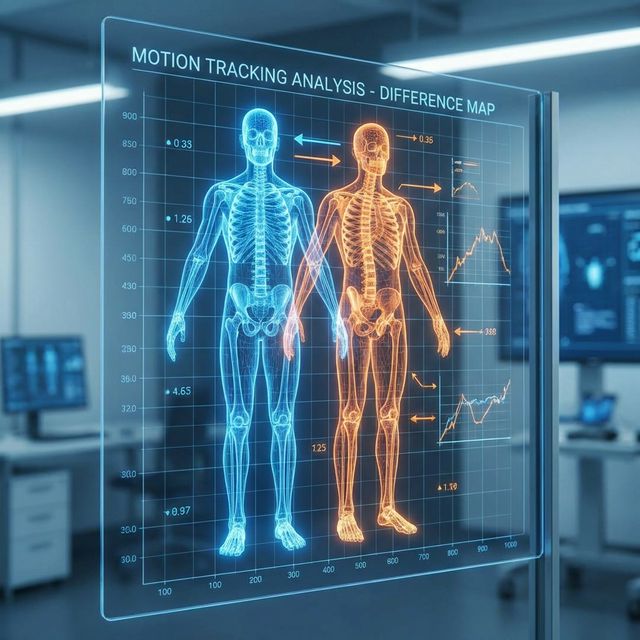
Supports multi-group experimental data storage, export, and comparison to generate parameter difference reports across test subjects and motion patterns. Simultaneously outputs kinematics, dynamics, and multi-dimensional data to support injury mechanism research, gait intervention validation, and other academic needs.
Teaching Practicals & Skill Development
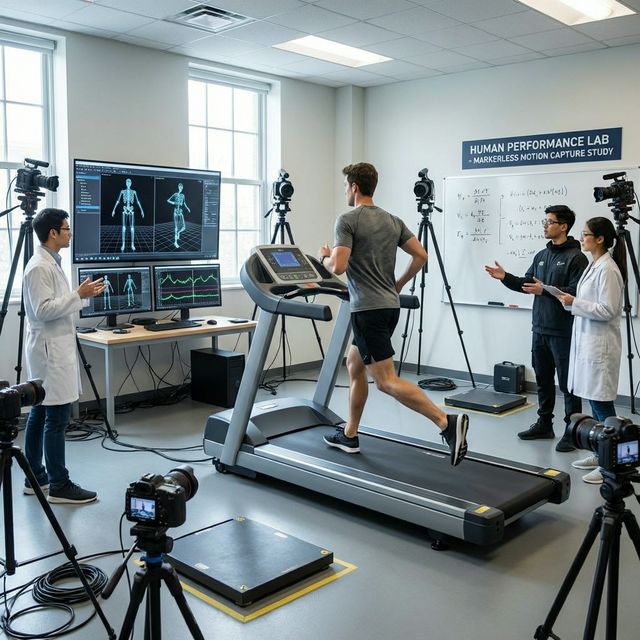
Built-in standardized experimental workflows and data interpretation templates enable students to independently complete the full "motion test → data collection → report analysis" workflow. The portable equipment adapts to classrooms and labs without requiring specialized technician support.
FAQ
How does HoloMotion support Advanced Bio-Research?
Empowering sports biomechanics teaching and laboratory research with markerless 3D motion capture, multi-modal data visualization, and research-grade data traceability. It uses markerless camera or video analysis to turn movement into reviewable gait, posture, ROM, symmetry, and functional metrics.
Who is this workflow designed for?
It is designed for clinical, sports, research, rehabilitation, wellness, and enterprise teams that need repeatable movement-assessment evidence without marker-based lab setup.
What should teams verify before deployment?
Teams should confirm local workflow requirements, consent, privacy handling, camera placement, and whether any jurisdiction-specific medical-device clearance is required for their use case.
Conference research and university projects
Follow each source to see the research question and project stage. Conference abstracts and institutional announcements complement the published application study; they are different forms of evidence.
Conference abstract · 2025
HPSC-51: functional-assessment repeatability
In 28 healthy participants, the study examined repeat assessments. Reliability varied by measure; the shoulder-pain score showed weaker between-day consistency.
This addresses repeatability, not universal clinical accuracy or future injury prediction. See abstract HPSC-51, printed page 50.
An exploratory comparison of 42 adults examined HoloMotion screening scores by age and sex. Authors list TAR UMT and Malaysia’s National Sports Institute.
Group differences in screening scores do not establish prospective injury prediction. See abstract HPSC-56, printed page 52.
The proceedings DOI identifies the collection, not separate full journal papers.
Plan a reproducible research protocol
Define population, tasks, reference system, coordinate/angle conventions, synchronization, repetitions and exclusions before collecting data. Record product and software versions alongside the protocol.
Separate repeatability, concurrent agreement and clinical or predictive utility. They answer different questions and require different designs. RMSE and MAE from different systems or experiments are not a direct accuracy ranking.
For an integration or export, request the actual field dictionary, units, timing information, missing-data handling, supported formats and a permitted sample file. Agree which data are raw, inferred or summary outputs before analysis.
Confirm consent, processing location, access permissions, retention and deletion responsibilities for the configured deployment. Identifiable motion video and clinical records should remain within the agreed research boundary.
From a research question to a reusable movement record
HoloMotion’s AI for Science workflow connects movement capture, reviewable measurements and domain interpretation. Start with a specific question and plan how the data will be checked, analyzed and retained before adding more tests.
For teaching, use supervised tasks to connect data acquisition with interpretation. For a research collaboration, agree participant consent, protocol ownership, data access and responsibility for analysis. Keep an institution’s public project announcement distinct from a completed study or a delivered installation.
Already have motion-capture equipment?
An AI data-processing service for existing motion-capture users is a different workflow from buying a markerless capture system. Begin with a permitted sample and document marker definitions, missing segments, coordinate conventions and the downstream analysis task.
For a pilot, agree what the algorithm may reconstruct, what must be flagged for review and how corrected output will be compared with the original. The proposed global SaaS direction should be evaluated through sample acceptance and expert review before a production service scope is agreed.
AutoMarker AI now provides an online institutional-access workflow for configured C3D gait data. Its current product page documents marker naming, the 79-label reference, input limits and account access. The September engineering evidence below remains a dated development sample, separate from this current service.
What the marker-service engineering evidence shows
Controlled native ARM64 acceptance on 8 September 2026 processed one static sample of 20 frames and one gait sample of 269 frames, each with 79 output markers. Each output passed an independent C3D validator and was retrieved through the normal delivery interface with a matching file hash.
The engineering workflow supports configured C3D static/gait inputs, retains the original file and separates execution, quality and delivery state. Expert acceptance, compatibility with the customer's downstream software and a second independent sample batch remain pilot steps. These small-sample results do not establish general accuracy, throughput or time saved.
The source API identifies itself as development version 0.2.0. The pilot pack explains request fields, review and delivery checks; it is separate from the markerless hardware integration API. Discuss sample access and an agreed layout with the team before transferring files. No public upload or self-service production service is implied.
Already have motion-capture equipment? Put your C3D data to work.
AutoMarker AI adds an online marker-labeling and review workflow for optical motion-capture gait data. Start with your lab's marker set and a static reference.