3D Running Form Analysis
Data-Driven Running Performance
Markerless · Fully Quantified · Rapid Assessment — covering runner training, injury prevention, and research
Core Advantages
Powered by 3D Vision AI, breaking through traditional assessment limitations
Markerless Precision Capture
No sensors or reflective markers needed. Single operator, 3m×4m space, avoiding wearable interference on running form.
Full-Dimension Quantification
Markerless camera-based movement analysis provides joint-angle and biomechanical outputs; available measures and capture settings depend on the configured product and protocol.
Multi-Version Adaptation
Basic version for daily assessment, Professional for biomechanics analysis, Research for kinematics/dynamics curve deep research.
Intuitive Reports & Recommendations
Auto-generates running form optimization, injury risk warnings, and shoe recommendations. Supports report download and multi-period comparison.
Feature Highlights
Covering the complete assessment workflow
High-Precision Data Capture
Markerless camera-based movement analysis provides joint-angle and biomechanical outputs; available measures and capture settings depend on the configured product and protocol.
Multi-Dimension Running Analysis
Covers landing type, trunk stability, lower limb alignment, arm swing coordination — comprehensive full-body kinematic analysis.
AI Intelligent Interpretation
Auto-generates personalized running form optimization suggestions, injury risk assessment, and shoe type recommendations.
Multi-Period Progress Tracking
Supports cross-session comparison of running data, visualizing improvement in training or rehabilitation progress.
Report Example
Structured report template, precisely quantifying assessment characteristics
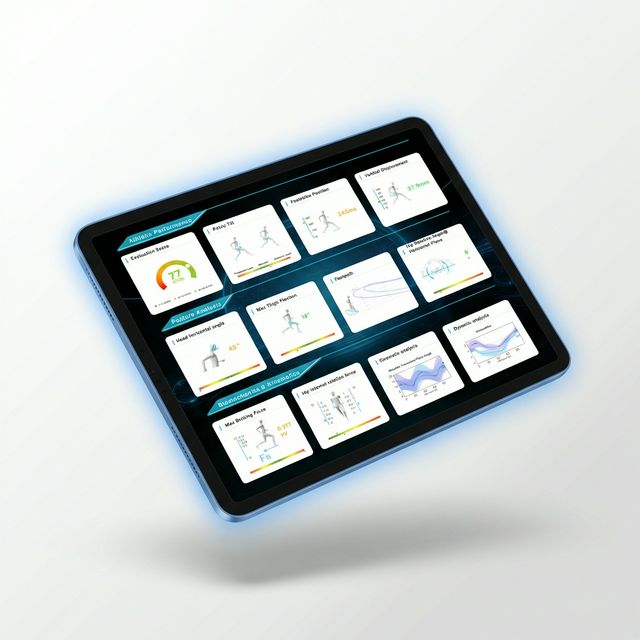
How to read and compare the report
The images on this page illustrate the HoloMotion report interface. Open the original image to inspect the layout; it is not a new accuracy experiment or evidence of treatment benefit.
Read parameter tables together with the recorded movement, side and angle convention. Check axes and units before comparing curves. A percentage displayed as a movement-risk index is not necessarily a calibrated probability of injury.
Before repeating an assessment, record product/version, task, camera position, lighting, clothing, assistance and trial-quality decisions. Compare only sufficiently similar trials and interpret change with professional context.