Timed Up-and-Go Test
Dual-Dimension Clinical Assessment
Automated TUG with synchronized gait analysis — dual assessment from a single test
Core Advantages
Powered by 3D Vision AI, breaking through traditional assessment limitations
Dual-Dimension Capture
One test simultaneously acquires timing data and full gait cycle information, eliminating repeated testing burden on patients.
Gait Symmetry Analysis
Automatically compares left/right stride length, joint angles, and muscle activation differences to precisely locate unilateral dysfunction.
Rehabilitation Tracking
Supports "timing trend graphs + gait parameter comparison tables" across multiple sessions, showing standing, walking, and balance recovery progress.
No Wearables Required
No markers, sensors, or additional personnel needed. Single operator completes the entire test.
Feature Highlights
Covering the complete assessment workflow
Standardized 3-Step Flow
Deploy equipment → Patient performs sit-stand-walk-turn-sit → Report generated in 1 minute. Total 3-minute closed-loop assessment.
Clinical Adaptations
Suitable for elderly fall risk screening, neurological patients (stroke, Parkinson's), post-orthopedic surgery, and balance disorder assessment.
Multi-Scene Deployment
Hospital outpatient, ward bedside, rehabilitation rooms, and community-level elderly health screening.
Report Example
Structured report template, precisely quantifying assessment characteristics
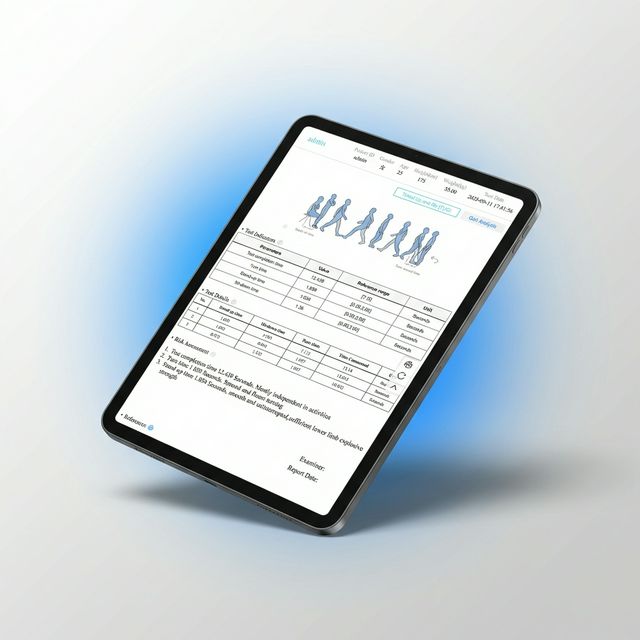
How to read and compare the report
The images on this page illustrate the HoloMotion report interface. Open the original image to inspect the layout; it is not a new accuracy experiment or evidence of treatment benefit.
Read parameter tables together with the recorded movement, side and angle convention. Check axes and units before comparing curves. A percentage displayed as a movement-risk index is not necessarily a calibrated probability of injury.
Before repeating an assessment, record product/version, task, camera position, lighting, clothing, assistance and trial-quality decisions. Compare only sufficiently similar trials and interpret change with professional context.